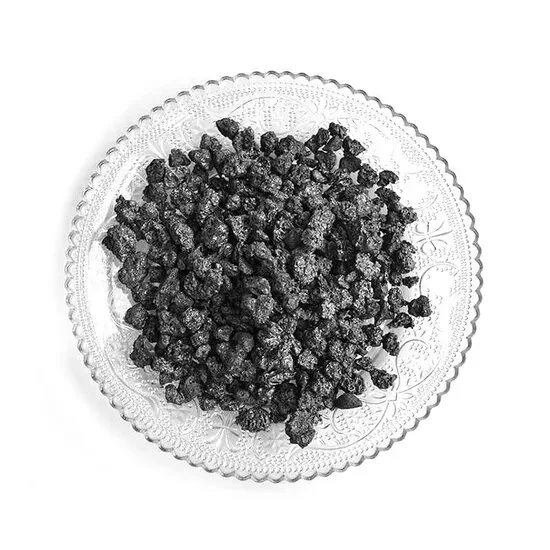
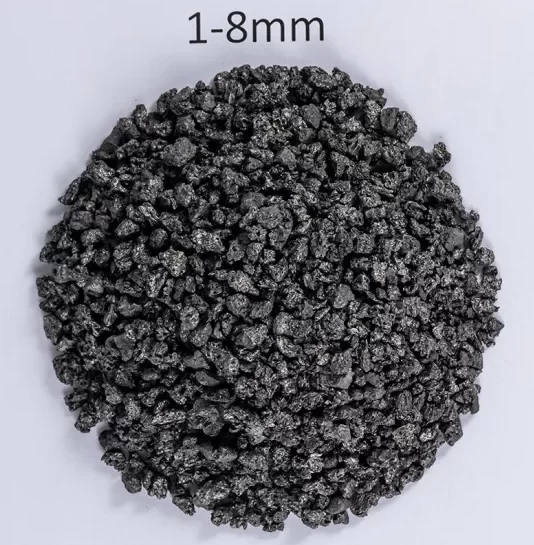
It can be used as a carbon raiser (carbon additive,recarburizer) to produce high quality steel, cast iron and alloy.It can also be used in plastic and rubber as an additive.
Advantages of GPC Graphitized Petroleum Coke
Our graphitized petroleum coke is meticulously crafted from calcined petroleum coke using a continuous graphitization process at temperatures of at least 2600°C. Post-crushing, screening, and classification, we provide a range of particle sizes from 0-50mm tailored to customer specifications. As an inoculant and carburizer, it plays a crucial role in special steel smelting and precision casting, adhering to high-quality standards with stringent sulfur control in ductile and grey iron casting industries. Additionally, it serves as a reducing agent in various applications, a heavy metal absorbent in wastewater treatment, and as a key raw material for graphite cathodes in aluminum electrolysis cells.
Graphitized Petroleum Coke Specifications
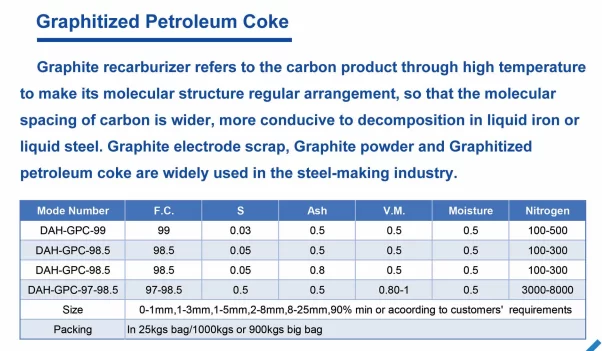
Graphitized Petroleum Coke should be selected according to the metallurgical process rather than by fixed carbon content alone. Key purchasing parameters typically include fixed carbon, sulfur, ash, volatile matter, moisture, nitrogen where required, and particle-size distribution.
Keep the existing Ding An Heng product specification table here.
Available particle sizes can be discussed according to customer requirements and production applications. For non-standard requirements, buyers can provide their target chemical specification and required size distribution for evaluation.
Applications of Graphitized Petroleum Coke
Graphitized Petroleum Coke is primarily used as a carbon raiser in metallurgical processes where manufacturers need to increase or precisely adjust the carbon content of molten metal. Its high carbon content and controlled impurity levels make it suitable for a variety of steelmaking and foundry applications.
In electric furnace steelmaking, GPC can be added during the melting process to supplement carbon and help achieve the required chemical composition. The appropriate addition method and quantity depend on the steel grade, furnace operation, raw materials, and target carbon level.
Foundries also use Graphitized Petroleum Coke in the production of cast iron, ductile iron, grey iron, and other cast products. For applications with strict sulfur requirements, selecting a suitable low-sulfur GPC specification can be particularly important. Particle size should also be matched to the charging process and furnace conditions to support effective dissolution and carbon absorption.
Beyond steelmaking and casting, GPC can serve as a carbon material in other metallurgical and industrial processes where high fixed carbon is required.
Ding An Heng supplies different GPC specifications and particle-size ranges for industrial buyers. Customers can provide their application, furnace information, target chemistry, and current carbon raiser specification so that a suitable product can be discussed before bulk purchasing.
How High-Temperature Graphitization Transforms Petroleum Coke Crystal Structure
Graphitized Petroleum Coke is produced by subjecting high-quality petroleum coke to an intensive graphitization process rather than simply applying heat for drying or calcination. The product information specifies a graphitization temperature of approximately 2,500–3,500°C, while the described continuous process uses temperatures of at least 2,600°C. At this stage, the carbon structure undergoes a fundamental transformation: the relatively disordered carbon structure of petroleum coke develops toward a crystalline, hexagonal, lamellar graphite structure. This structural change is the defining feature of graphitized material and is directly related to its performance as a carbon material.
For engineers evaluating graphitized petroleum coke manufacturers, the graphitization process is therefore more important than simply looking at whether a material is described as “high-temperature treated.” The objective is to obtain a stable graphitized carbon structure with high fixed carbon, low sulfur, low ash and low porosity. These characteristics make the material suitable for applications where carbon quality and impurity control influence the final metallurgical result.
The product page also identifies low sulfur, low ash, low porosity and high fixed carbon as important characteristics. These properties are particularly relevant when carbon additions must be controlled without unnecessarily introducing additional impurities into molten metal. For procurement teams comparing graphitized petroleum coke suppliers, it is therefore useful to evaluate the material from three connected perspectives: the quality of the petroleum coke feedstock, the graphitization process and the resulting physical specification after crushing and screening.
The final processing stage also affects how the material can be incorporated into an existing production process. After graphitization, the material is crushed, screened and classified, with particle sizes available across a 0–50mm range according to customer requirements. This means the purchasing decision is not limited to chemical composition; particle-size suitability should also be considered alongside the intended charging or addition process.
From an engineering perspective, this process route explains why graphitized petroleum coke should be evaluated as a specialized carbon material rather than treated as an interchangeable form of petroleum coke. The transformation from a disordered carbon structure toward a crystalline graphite structure provides the foundation for its use in steelmaking, precision casting, foundry applications and other carbon-related industrial processes.
Metallurgical Benefits of GPC as Both Recarburizer and Inoculant
The metallurgical value of recarburizer is normally associated with increasing the carbon content of molten metal, but graphitized petroleum coke can provide a broader function in foundry applications because the product is described as both a carburizer and an inoculant. This dual role is one of the key technical characteristics to consider when selecting a carbon material for steelmaking, cast iron and precision casting.
As a carbon addition, graphitized petroleum coke is used to raise carbon levels during the production of steel, cast iron and alloys. Its high fixed carbon content provides a concentrated carbon source, while the low sulfur and low ash characteristics help maintain control over unwanted impurities. For production engineers, this makes carbon purity and impurity levels important evaluation points when comparing different graphite recarburizer options.
The second role is related to graphite nucleation in iron. According to the product information, graphite petroleum coke can promote the nucleation of graphite in iron solution, increase the amount of ductile iron and contribute to the organization and grade of grey cast iron. Microstructural observations described for the product indicate increased ferrite content in ductile iron and an increased proportion of V-shaped and VI-shaped graphite. These characteristics make the material relevant not only to carbon adjustment but also to the metallurgical development of cast iron.
This distinction is particularly important when assessing the function of a recarburizer manufacturer. A material should not be evaluated solely according to its carbon percentage. Its sulfur level, ash content, porosity, particle-size distribution and metallurgical behavior can all affect how it fits into a production process. A suitable material must ultimately match the requirements of the melt, the casting process and the desired final structure.
Another point highlighted by the product information is the potential reduction in dependence on expensive nucleating agents during later fine adjustment. The described microstructural effect indicates that increasing the amount of nodular graphite can reduce the need for additional nucleating agents in subsequent adjustment stages. For foundry operations, this creates a potential process-cost advantage while keeping the focus on metallurgical control rather than simply increasing carbon input.
The material is also positioned for special steel smelting and precision casting, with stringent sulfur control identified as an important consideration for ductile and grey iron casting. This makes impurity management particularly relevant when selecting a carbon additive. Procurement teams can therefore assess a recarburizer according to the complete technical profile rather than treating all carbon raisers as equivalent materials.
In practical terms, the combination of carburizing and inoculating functions gives graphitized petroleum coke a more specialized role in metallurgical production. It can contribute to carbon adjustment while also supporting the graphite nucleation behavior required in selected iron casting processes. This is why the material should be evaluated in relation to the complete melting and casting process, including raw-material quality, particle size and the required metallurgical outcome.
Graphitized Petroleum Coke vs Calcined Petroleum Coke: Which Carbon Raiser Should You Choose?
Graphitized Petroleum Coke (GPC) and Calcined Petroleum Coke (CPC) are both carbon materials used across metallurgical industries, but they should not automatically be treated as interchangeable products. The appropriate choice depends on the required carbon level, impurity limits, metallurgical process, and purchasing budget.
One of the important differences is the processing route. GPC undergoes an additional high-temperature graphitization process, which changes the carbon structure and helps produce material suitable for applications requiring high fixed carbon and tightly controlled impurities. This makes Graphitized Petroleum Coke an important carbon raiser option for steel mills and foundries with demanding production requirements.
CPC can also be an effective carbon material where its chemical specification satisfies the process requirements and may offer a different cost-performance balance. Therefore, the purchasing decision should not simply be based on the assumption that one material is universally better.
Buyers should compare fixed carbon, sulfur, ash, volatile matter, moisture, nitrogen where relevant, particle size, and expected performance in their actual furnace conditions.
Ding An Heng supplies both graphite and carbon products, enabling customers to evaluate GPC according to their specific metallurgical requirements. If you are replacing an existing carbon raiser, send us its specification or certificate of analysis for comparison.
How to Choose Graphitized Petroleum Coke for Steelmaking and Foundry Applications
Choosing the right Graphitized Petroleum Coke requires more than finding the highest fixed carbon value on a datasheet. Steel mills and foundries should evaluate the complete specification because different production processes can require different combinations of carbon content, impurity control, and particle size.
Fixed carbon is naturally one of the main purchasing parameters. However, sulfur and ash should also be carefully evaluated, especially when the final steel or casting has strict chemical requirements. Depending on the application, buyers may additionally specify limits for moisture, volatile matter, and nitrogen.
Particle size is another important consideration. Different furnace conditions and charging methods may require different GPC size distributions. Rather than choosing particle size solely according to availability or price, buyers should consider how the material will be introduced into the furnace and how effectively it needs to dissolve and release carbon into the molten metal.
Consistency is equally important for repeat purchasing. A trial sample may meet the required specification, but industrial users also need confidence that subsequent shipments will remain within the agreed parameters.
When contacting Ding An Heng, buyers can provide their required fixed carbon, sulfur, ash, nitrogen if applicable, particle size, monthly consumption, and application. Existing GPC specifications or COAs can also be supplied for reference. This makes product matching more precise and helps avoid purchasing a carbon raiser that looks suitable on paper but does not match the actual production requirement.
What Determines Graphitized Petroleum Coke Price?
The graphitized petroleum coke price can vary considerably according to raw materials, product specifications, processing costs, particle size, order quantity, packaging, and transportation. For this reason, buyers should be cautious when comparing GPC offers based only on a headline price per ton.
Raw petroleum coke quality is an important cost factor, while graphitization is an energy-intensive production stage. Changes in feedstock and energy costs can therefore affect GPC quotations.
Product specifications also have a significant influence. Requirements for high fixed carbon, low sulfur, controlled ash, specific nitrogen limits, or tighter particle-size distribution may involve different raw-material selection and processing requirements. Two products both described as “Graphitized Petroleum Coke” may therefore represent different grades and should not be compared solely by price.
Commercial conditions also matter. Quantity, packaging, delivery schedule, inland transportation, international freight, destination port, and Incoterms can change the final landed cost. A factory quotation based on EXW terms cannot be directly compared with a CIF quotation without accounting for logistics and related expenses.
For an accurate graphitized petroleum coke price, Ding An Heng recommends sending a complete RFQ containing the required specification, particle size, quantity, packaging, destination country or port, and preferred Incoterm.
This allows buyers to compare equivalent GPC specifications and obtain pricing based on their actual purchasing requirements rather than a generic market reference.
How to Evaluate Graphitized Petroleum Coke Manufacturers and Suppliers in China
There are many graphitized petroleum coke manufacturers and trading companies in the market, so international buyers should evaluate potential partners using both technical and commercial criteria.
The first consideration is specification capability. Reliable graphitized petroleum coke suppliers should be able to clearly define key parameters such as fixed carbon, sulfur, ash, volatile matter, moisture, particle size, and other customer-required indicators. Buyers should also discuss quality inspection and the documentation available for shipments.
Consistency between batches deserves particular attention. Steel mills and foundries generally purchase carbon raisers repeatedly, meaning long-term specification stability can be more valuable than obtaining an unusually low price for a single shipment.
Production and supply capability should then be evaluated. Ask about available specifications, particle-size processing, MOQ, monthly supply capability, normal production lead time, packaging options, and the supplier's experience with export shipments.
Commercial communication is another useful indicator. A professional supplier should ask about the application and technical requirements rather than quoting a generic product immediately without understanding how it will be used.
Ding An Heng has more than 20 years of experience in graphite and carbon products and serves international industrial markets with products including Graphitized Petroleum Coke, graphite electrodes, Calcined Petroleum Coke, and other carbon materials.
Buyers can submit their current product specification or purchasing requirements to compare technical parameters before proceeding with trial or bulk orders.
Why Source Graphitized Petroleum Coke Directly from a Factory?
Working with a graphitized petroleum coke factory can be particularly useful for steel mills, foundries, importers, and distributors that require repeat orders, customized particle sizes, or specific chemical parameters.
Direct factory communication allows technical requirements to be discussed at an earlier stage of procurement. Instead of selecting only from a generic product description, buyers can provide target fixed carbon, maximum sulfur and ash levels, particle-size distribution, packaging, and expected purchasing volume.
Customization is especially valuable when standard particle sizes do not match the buyer's furnace or charging process. Crushing and screening requirements can be discussed according to the intended application, subject to production feasibility and order conditions.
Direct sourcing can also simplify communication concerning production schedules, quality documentation, packaging, container loading, and recurring shipment plans. However, buyers should not assume that every company describing itself as a factory offers the same capabilities. Production facilities, quality-control procedures, specification stability, export experience, and technical communication should still be verified.
Ding An Heng operates in the graphite and carbon products industry and supplies GPC for metallurgical applications. For customers looking for a long-term source of Graphitized Petroleum Coke, the company can discuss bulk supply and customized requirements according to the buyer's specification.
Send your required grade, particle size, quantity, application, and destination to Ding An Heng for product matching and quotation.
Why Choose Ding An Heng for Graphitized Petroleum Coke?
Industrial carbon purchasing depends on more than receiving material with a high carbon percentage. Buyers also need specification consistency, appropriate particle sizes, reliable production planning, and responsive technical and export communication.
Ding An Heng has more than 20 years of experience in graphite and carbon products and provides products for steelmaking, foundry, and other industrial applications. Its product portfolio includes Graphitized Petroleum Coke, graphite electrodes, Calcined Petroleum Coke, and related carbon materials, enabling buyers to source according to different metallurgical requirements.
For GPC purchasing, Ding An Heng can work with customers on chemical specifications, particle-size requirements, bulk quantities, packaging, and export arrangements. Buyers replacing an existing supplier can provide their current specification or COA for comparison, while new projects can submit target parameters and application information.
Whether you are a steel mill, foundry, importer, distributor, or industrial purchasing company, Ding An Heng aims to provide a clear quotation based on actual specifications rather than a generic GPC price.
Contact Ding An Heng with your required fixed carbon, sulfur, ash, particle size, order quantity, and destination for further evaluation.
Graphitized Petroleum Coke FAQs
What is Graphitized Petroleum Coke?
Graphitized Petroleum Coke, commonly abbreviated as GPC, is a high-carbon material produced from petroleum coke through high-temperature processing and graphitization. It is widely used as a carbon raiser in steelmaking, foundry, casting, and related metallurgical applications.
What is Graphitized Petroleum Coke used for?
GPC is commonly used to increase or adjust carbon content during steelmaking and casting. Applications include electric furnace steel production, cast iron, ductile iron, grey iron, and other metallurgical processes requiring a high-carbon material with controlled impurities.
What is the difference between GPC and CPC?
GPC undergoes graphitization in addition to earlier thermal processing, while CPC is calcined petroleum coke without the same graphitization stage. Their carbon structure, specifications, production costs, and suitability for particular metallurgical processes can therefore differ.
How do I choose the right GPC specification?
Start with your required fixed carbon, maximum sulfur and ash levels, nitrogen requirement if applicable, and particle size. The appropriate specification should then be matched to your furnace, raw materials, final product, and charging process.
What affects graphitized petroleum coke price?
Raw petroleum coke, energy and graphitization costs, chemical specifications, particle size, quantity, packaging, freight, and delivery terms can all affect the final price. Buyers should compare quotations based on equivalent specifications and Incoterms.
Can Ding An Heng provide customized particle sizes?
Particle-size requirements can be discussed according to the customer's application and purchasing specification. Send Ding An Heng the required size range, chemical parameters, quantity, and application to confirm production feasibility.
How can I get a Graphitized Petroleum Coke quotation?
Provide the required fixed carbon, sulfur, ash, moisture, nitrogen if required, particle size, quantity, packaging, destination port, and preferred Incoterm. Providing an existing specification or COA can make product matching and quotation more accurate.