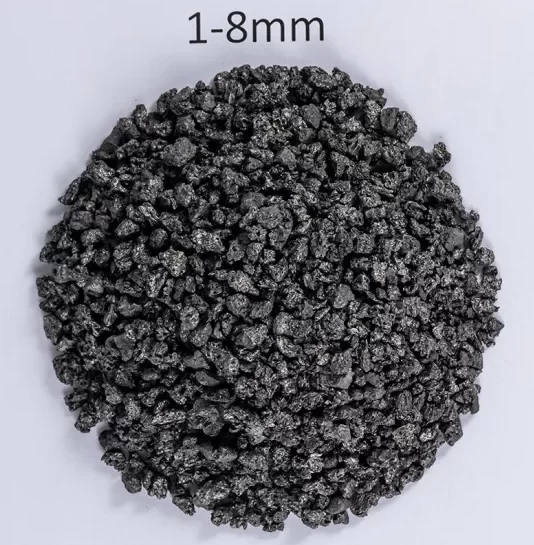
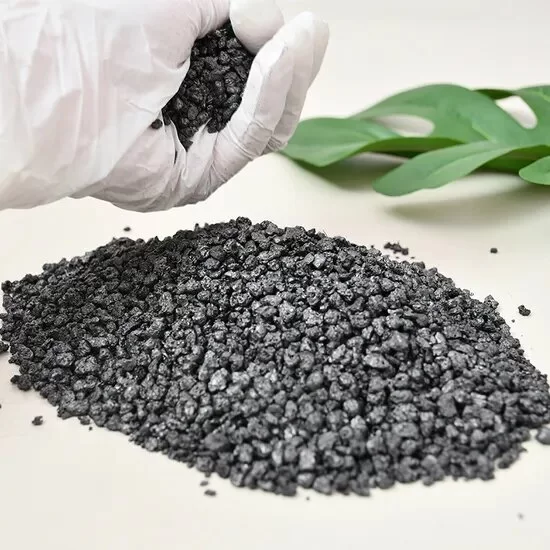
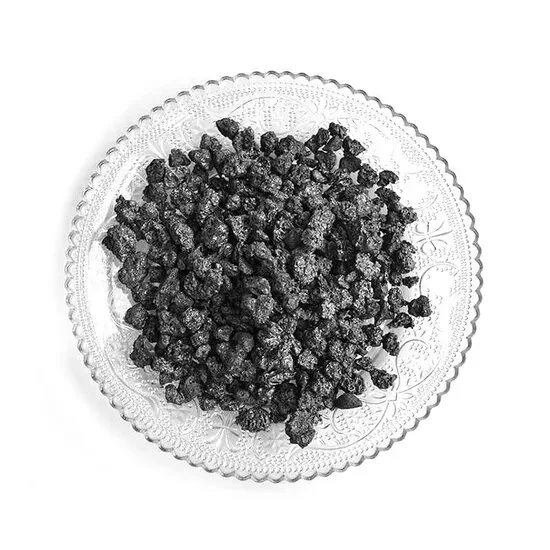
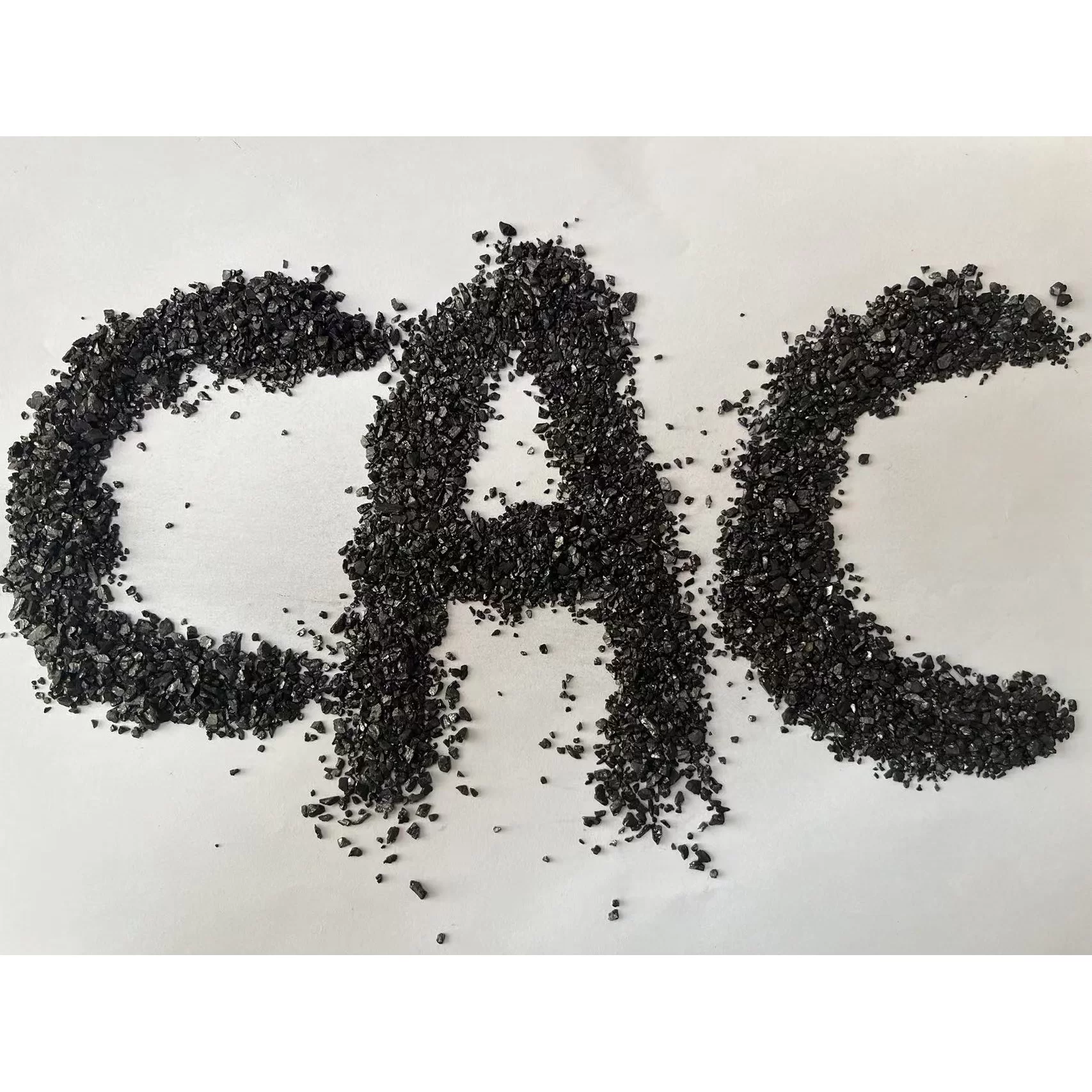
Calcined Petroleum coke is a carbon material formed by high-temperature calcination (1200-1500 ℃) of petroleum coke (a byproduct of oil refining) to remove volatile matter and moisture. Its essence is to convert low purity raw coke into structurally stable and performance optimized calcined coke through physical and chemical reactions, which is widely used in high-end fields such as electrolytic aluminum, graphite electrodes, and lithium batteries.
Calcined Petroleum Coke (CPC) – Features & Advantage
1. Key Features
High Fixed Carbon (98–99.5%)– Ensures superior conductivity and carbon yield in industrial processes.
Low Sulfur (0.3–0.8%) – Minimizes pollution and improves metal quality in aluminum/steel production.
Low Ash (0.5–1.2%) – Reduces impurities in end products (e.g., anode blocks, refractories).
Controlled Particle Size (0.5–25mm) – Customizable for optimal performance in carburizing or anode paste.
High Thermal Stability – Withstands temperatures up to 1,500°C without degradation.
2. Competitive Advantages
Cost-Effective
· Replaces premium carbon additives (e.g., graphite) at 30–50% lower cost while maintaining performance.
Process Efficiency
· Faster Carburization: Uniform particle size ensures rapid dissolution in molten metal (steel/iron).
· Reduced Energy Use: Low volatile matter (≤0.5%) cuts furnace energy consumption.
Custom Solutions
· Tailored blends for specific needs (e.g., ultra-low sulfur for Li-ion battery anodes).
Reliable Supply
· Vertical integration from raw coke to calcined product ensures stable quality and volume.
· Strategic stock for fast delivery.
Graphitized Petroleum Coke and the High-Temperature Calcination Process
Calcined Petroleum Coke is produced by high-temperature calcination of petroleum coke, which is a byproduct of oil refining. The supplied product is processed at 1200–1500°C to remove moisture and volatile matter and transform the original petroleum coke into a structurally stable carbon material. This thermal treatment is the foundation of its use in electrolytic aluminum, graphite electrode production, lithium battery-related applications, and other industrial carbon processes.
The raw petroleum coke is first selected as the feedstock for calcination. During high-temperature treatment, moisture and volatile components are removed through physical and chemical changes. According to the supplied product information, the finished material contains 98–99.5% fixed carbon and no more than 0.5% volatile matter. The reduction of volatile components gives the material a more stable composition for subsequent industrial processing.
The calcination temperature is a key part of the manufacturing process. Treatment at 1200–1500°C changes the structure and physical characteristics of the petroleum coke while improving its thermal stability. The supplied information indicates that the finished material can withstand temperatures up to 1500°C without degradation, which is relevant to high-temperature carbon applications.
It is useful to distinguish Calcined Petroleum Coke from Graphitized Petroleum Coke when evaluating carbon raw materials. Although both are carbon materials, they represent different processing categories and should not automatically be considered interchangeable. Calcined Petroleum Coke is defined here by its petroleum-coke feedstock and high-temperature calcination process, while selection between different carbon materials should depend on the requirements of the intended application.
Particle size is also controlled as part of the product specification. The supplied range is 0.5–25 mm, providing different physical sizes for applications such as carburizing and anode paste. For industrial procurement, particle size should be considered together with fixed carbon, sulfur, ash, and volatile matter rather than evaluated separately.
The resulting material therefore combines the characteristics created by the original petroleum-coke feedstock and the high-temperature calcination process. For users comparing Calcined Petroleum Coke with Graphitized Petroleum Coke, understanding the processing route helps establish whether the material is appropriate for the intended carbon application.
Recarburizer Carbon Properties for Controlled Carbon Addition
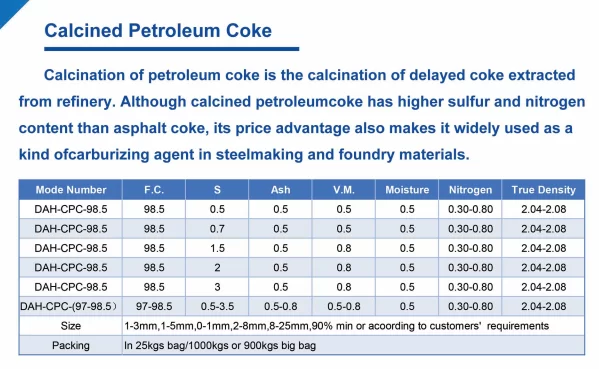
Calcined Petroleum Coke has a high fixed-carbon content and controlled impurity levels, making it suitable for applications where concentrated carbon material is required. The supplied specification lists fixed carbon at 98–99.5%, sulfur at 0.3–0.8%, ash at 0.5–1.2%, and volatile matter at no more than 0.5%. These characteristics provide a clear technical basis for evaluating the product as a carbon additive.
As a recarburizer carbon material, high fixed carbon is one of the most important properties. A high fixed-carbon level means that the product provides a concentrated carbon component for processes requiring carbon adjustment. The low ash range also helps control the amount of non-carbon residue introduced together with the material.
Sulfur is another important parameter in material selection. The supplied product has sulfur controlled at 0.3–0.8%, while ash is maintained at 0.5–1.2%. These values allow industrial buyers to assess the product according to the impurity limits required by their process. Instead of evaluating a carbon material only by its carbon content, procurement teams can review fixed carbon, sulfur, ash, and volatile matter as a complete specification.
The calcination process contributes directly to the low volatile matter characteristic. The supplied product has a maximum volatile matter level of 0.5%, reflecting the removal of volatile components during high-temperature processing. This gives the finished material a more stable profile than the original petroleum coke feedstock.
The particle-size range is 0.5–25 mm. Controlled particle size can be important for feeding, handling, and material distribution within an industrial process. The appropriate size should therefore be selected according to the requirements of the receiving production system.
The recarburizer carbon application should also be considered alongside the product's other industrial uses. Calcined Petroleum Coke is used for pre-baked anode production in electrolytic aluminum, graphite electrode production, and lithium battery-related carbon applications. This means the product is not limited to one processing route.
For buyers researching recarburizer, technical compatibility should remain the starting point. Fixed carbon and impurity levels provide the basic information needed to determine whether the supplied material fits the required carbon-addition process. The final selection should then consider particle size and the operating requirements of the receiving facility.
Coal Recarburizer and Calcined Petroleum Coke Application Differences
Carbon materials can serve different industrial purposes depending on their raw materials, processing routes, chemical composition, and physical characteristics. Calcined Petroleum Coke and coal recarburizer may both be considered when a carbon material is required, but they should not be treated as identical products. Material selection should be based on the technical requirements of the actual application.
Calcined Petroleum Coke is produced from petroleum coke through high-temperature calcination at 1200–1500°C. The supplied product has fixed carbon of 98–99.5%, sulfur of 0.3–0.8%, ash of 0.5–1.2%, and volatile matter of no more than 0.5%. These values define the specific material profile available from the supplied product information.
A coal recarburizer represents another category of carbon material. When comparing it with Calcined Petroleum Coke, buyers should review the actual specification of each material rather than assuming that their performance is identical. Fixed carbon, sulfur, ash, volatile matter, and particle size are useful parameters for establishing whether a particular material fits the intended process.
The application itself should determine which characteristics receive the greatest attention. For carbon-addition applications, fixed carbon and impurity control can be important. For electrolytic aluminum and anode production, the chemical profile and particle size of the carbon raw material need to correspond with the production requirements. For graphite electrode and lithium battery-related applications, the material should similarly be evaluated against the requirements of the relevant carbon-processing route.
The supplied Calcined Petroleum Coke has a particle-size range of 0.5–25 mm. This provides different physical options for industrial processing and is specifically identified as suitable for applications such as carburizing and anode paste. Particle size should be confirmed before procurement because the feeding and processing system can determine the appropriate material form.
The term recarburizer describes a carbon material used for carbon adjustment, but the term itself does not establish the quality or suitability of a particular product. A technical evaluation should always return to the measurable characteristics of the material.
For purchasers comparing carbon raw materials, coal recarburizer and Calcined Petroleum Coke should therefore be assessed separately according to their specifications and intended applications. Products such as semi coke may also appear during carbon-material sourcing, but different carbon materials should be selected according to their actual technical requirements rather than their names alone.
Recarburizer Meaning and Industrial Selection Considerations
Understanding recarburizer meaning helps industrial purchasers evaluate why Calcined Petroleum Coke can be used in carbon-addition applications. A recarburizer is a carbon material used to adjust carbon content during an industrial process. For Calcined Petroleum Coke, the high fixed-carbon content and controlled impurity levels provide the primary characteristics relevant to this role.
The supplied product contains 98–99.5% fixed carbon. This high carbon concentration is a central part of the product profile and provides a concentrated carbon source. At the same time, sulfur is specified at 0.3–0.8%, ash at 0.5–1.2%, and volatile matter at no more than 0.5%. These parameters allow buyers to assess the material against the requirements of their own process.
When considering recarburizer meaning in practical procurement, it is important not to treat every carbon additive as equivalent. Different raw materials and processing methods can produce different chemical and physical characteristics. For this reason, fixed carbon should be evaluated together with sulfur, ash, volatile matter, and particle size.
Calcined Petroleum Coke has a controlled particle-size range of 0.5–25 mm. The supplied information identifies controlled particle size as one of its advantages for carburizing and anode paste applications. The correct size should be determined according to the feeding method and processing conditions of the receiving facility.
The product also has applications beyond carbon addition. It is used as a raw material for pre-baked anodes in electrolytic aluminum production and for graphite electrode and lithium battery-related carbon applications. Its high fixed carbon and low impurity levels therefore support several industrial requirements.
For buyers evaluating recarburizer, cost should not be considered separately from technical suitability. A lower material price does not necessarily provide the appropriate specification for a particular production process. The required fixed carbon, sulfur, ash, volatile matter, and particle size should be established first, followed by commercial comparison.
The same principle applies when evaluating recarburizer meaning in relation to other carbon materials. A product should be selected according to the role it needs to perform and the specification required by the production system. This approach helps prevent unsuitable material substitutions and keeps procurement decisions aligned with actual process conditions.
Recarburizer Price and Calcined Petroleum Coke Specification for Procurement
When reviewing recarburizer price, industrial buyers should consider the complete material specification rather than comparing commercial figures alone. Calcined Petroleum Coke is available with defined ranges for fixed carbon, sulfur, ash, volatile matter, and particle size. These parameters provide a technical basis for evaluating whether the product meets the requirements of a specific application.
Property | Calcined Petroleum Coke |
Calcination Temperature | 1200–1500°C |
Fixed Carbon | 98–99.5% |
Sulfur | 0.3–0.8% |
Ash | 0.5–1.2% |
Volatile Matter | ≤0.5% |
Particle Size | 0.5–25 mm |
Thermal Stability | Up to 1500°C |
The fixed-carbon range of 98–99.5% is particularly important when the product is evaluated as a recarburizer. The supplied sulfur range of 0.3–0.8% and ash range of 0.5–1.2% provide additional information for assessing impurity control. Volatile matter is limited to no more than 0.5%, reflecting the high-temperature calcination process.
Particle size should also be included when reviewing the material specification. The available range of 0.5–25 mm provides options for different industrial applications. The supplied information specifically identifies controlled particle size as suitable for carburizing and anode paste, so the required size should be established before placing an order.
The meaning of recarburizer price can vary depending on the material grade and specification being compared. A price comparison is more useful when the products have comparable fixed-carbon levels, impurity limits, volatile matter, and particle size. Comparing materials only by their product names can result in an inaccurate assessment of their actual value.
For users evaluating recarburizer carbon, the same specification-based approach can be applied. The high fixed carbon of Calcined Petroleum Coke, together with controlled sulfur and ash, forms the core of its carbon-material profile. Its applications in electrolytic aluminum, graphite electrodes, and lithium battery-related carbon materials further demonstrate the importance of selecting the material according to its intended use.
Other carbon products may also appear during industrial sourcing. For example, coke coal for sale may be considered for a different material requirement, but it should not automatically be treated as an equivalent to Calcined Petroleum Coke.
Ultimately, the most effective procurement process starts with defining the required specification and then comparing suitable materials. For Calcined Petroleum Coke, fixed carbon, sulfur, ash, volatile matter, particle size, and the 1200–1500°C calcination process provide the key technical references for evaluating suitability and commercial value.
Specification